


Under the Hammer

One of the most easily recognisable of all sharks are the magnificent hammerheads. That iconic face, known to scientists as a "cephalofoil" , means you would be heard-pressed to find any person who could not put a name to these incredible animals. But what many people don't realise is that there is not a single type of hammerhead. In fact, there are 10 distinct species of hammerheads, all with a uniquely shaped cephalofoils that all serve different functions in their lives. So why did these cephalofoils evolve? How does it benefit these sharks? And how does the cephalofoil compare between the various species of hammerheads?

Heads Up!
Hammerheads are a part of the largest lineage of sharks on the planet today: the order Carcharhiniformes aka ground sharks, which includes all the reef sharks (Carcharhinus species), catsharks (Scylliorhinidae) and the tiger shark (Galeocerdo cuvier), to name but a few. The family of hammerheads now consists of ten different species in two genera (Compagno, 1984; Mara, 2010).

The binomial names for hammerheads come from the Greek word "sphyra" which literally means 'hammer' - to describe the bizarre shape of their heads. Hilariously, the genus Eusphyra, which only includes the winghead shark (Eusphyra blochii) - is spelled differently to all the other hammerheads in the genus Sphyrna. It's thought that this is literally a typo - with the scientists who first named the group accidentally adding an n that should not have been there (Compagno, 1984).
What a fun little quirk of history!

Spreading Your Wings
Every species of hammerhead shark has had a completely unique cephalofoil. For example, in the great hammerhead (S. mokarron), the leading edge is remarkably straight. Comparatively, the bonnethead shark's (S. tiburo) cephalofoil is distinctly rounded and the scalloped hammerhead (S. lewini) is so-named because the front of the cephalofoil has pretty crenellations (Compagno, 1984; Mara, 2010).
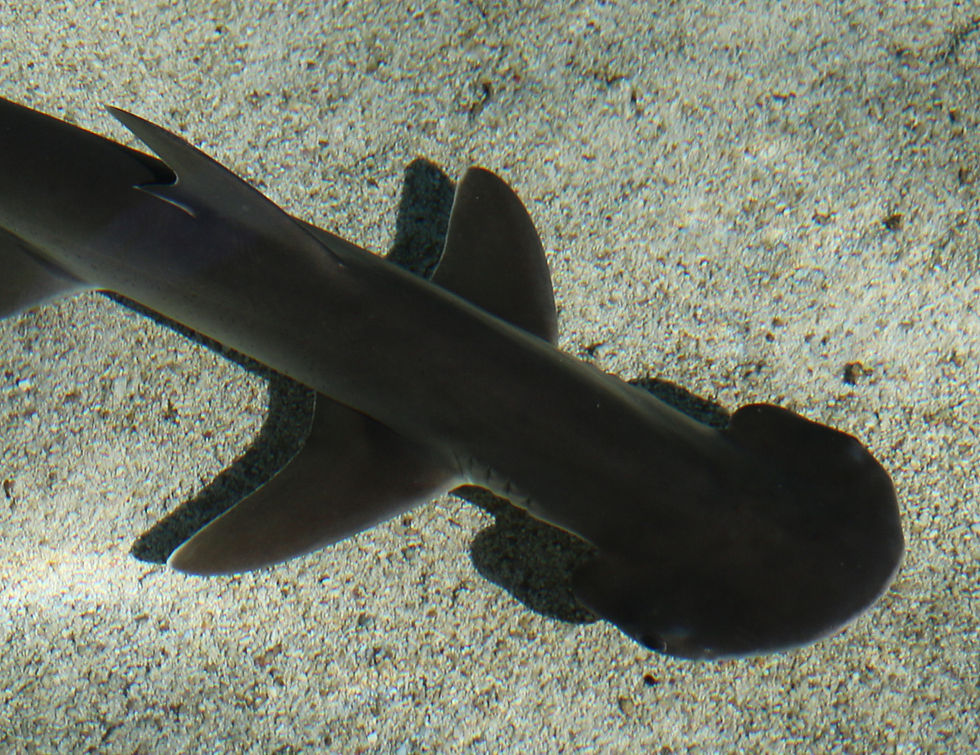
The largest wings of the aptly-named winghead shark (Eusphyra blochii) can be as long as half the total body length of the shark. Comparatively, the species with the smallest cephalofoil is the bonnethead, with the extension of the wings reaching only 18% of the total body length (Compagno, 1984; Mara, 2010).
The first hammerhead sharks are dated back to 55 million years ago, making them some of youngest of all shark species. In the deep past, the wings of these primitive cephalofoils were especially long. These early cephalofoils then evolved along two different lineages; with the wings becoming increasingly extended in the arm of the tree that gave rise to the winghead shark and the cephalofoil contracting in the lineage that gave rise to all the Sphyrna species. This means species with the shorter cephalofoils evolved most recently (Compagno, 1984; Mara, 2010).

Ahead of the Rest
Inside the cephalofoil, stiffened cranial cartilage holds the wings in shape. But why did hammerheads evolve this bizarre (but fantastic!) head? What is its function? Several different theories have been put forward to explain why the these shark have hammer-shaped heads.
The hypothesis that has gained the most weight is the idea that the cephalofoil provides the hammerheads an advantage in sensory perception. As the cephalofoil is formed by the lateral expansion of the head, the structures associated with the face - smelling organs, visual systems and other sensory organs - are also expanded outwards. So hammerheads' eyes and nostrils are very far apart, and their other sensory organs cover an expanded surface area compared to other sharks (Compagno, 1984; Kajiura et al, 2005; Mara, 2010).

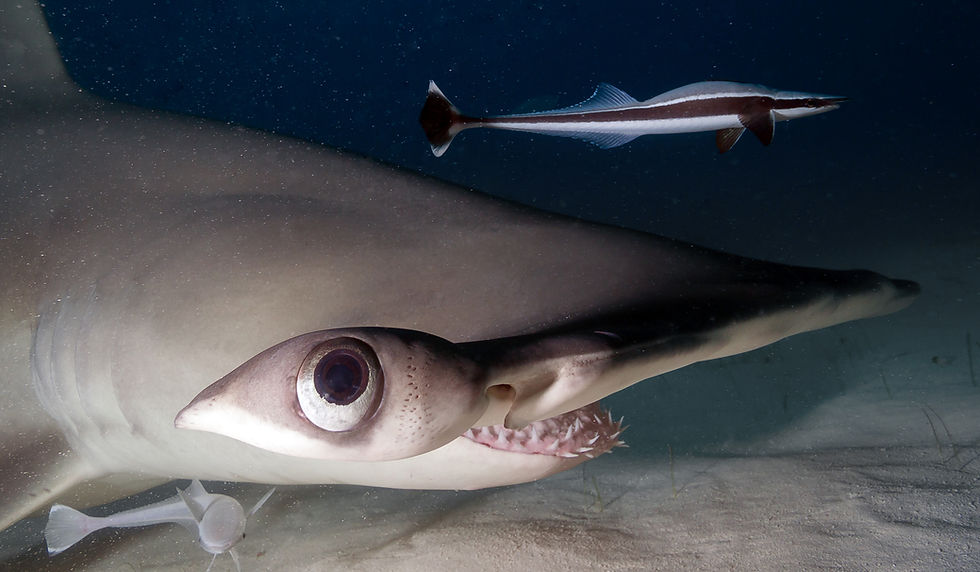
The 'enhanced binocular vision hypothesis' suggests that the cephalofoil lengthen because it helped with sight. Because the eyes are positioned so far along the wings, the cephalofoil provides hammerheads incredibly wide visual fields; so they can see above and below their bodies, and have only very small blind spots behind them. They can literally see out the back of their heads! They also have large areas of "binocular overlap" in front of their faces, which means that they have excellent depth perception (Compagno, 1984; McComb et al, 2009; Mara, 2010). To learn more about shark vision check out Myth Busted: Sharks DO NOT Have Bad Eye Sight and True Colours.

Finally, the 'enhanced electrosensory hypothesis', suggests that the larger surface area of the cephalofoil allows for greater density of "Ampullae of Lorenzini" (jelly-filled pores responsible for detecting electrical fields), which confers the hammerheads remarkable electrosensory capabilities. The extended length of the ampullae pores along the cephalofoil, provide hammerheads greater sensitivity to electrical fields. This allows them to detect the electrical signal produced by muscle contraction in their prey, so they can find an animal even if it buried in sand! The increased distance across the cephalofoil also allows the hammerheads remarkable acuity to perfectly orient their body against an electrical field, which allows them to navigate towards prey very precisely. It is also thought that this ability may be responsible for hammerheads' remarkable long-distance navigation; allowing them to align their body against geomagnetic fields for directed swimming over incredible distances (Compagno, 1984; Kajiura, 2001; Kajiura et al., 2005; Mara, 2010).
To learn more about sharks' sensory capabilities, head over to Sixth Sense.

Bringing the Hammer Down
Believe it or not sharks are negatively buoyant. This means they are heavier than the water they swim in, so, if they stopped swimming they would sink. To counter this, sharks need to create lift, like an aeroplane (Nakaya, 1995; Driver, 1997; Gaylord et al, 2020).

One way this is achieved is by having large, flat "pectoral fins" (paired fins on the side of the body), which act just like the wings on a plane. Scientists suspect that the cephalofoil contributes to this lift because hammerheads with larger wings, have smaller pectoral fins. It's thought that the shape of the cephalofoil means that, as water runs over the flat surface, lower pressure is created on the dorsal side, lifting the body upwards (Nakaya, 1995; Driver, 1997; Gaylord et al, 2020).
Scientists also suspect that the cephalofoil has allowed hammerhead sharks exceptional agility. The large surface area of the extended arms and the camber, mean the cephalofoil catches the water acutely. As the head has strong musculature, the shark can tip their head sideways, and lift and decompress the plane of the cephalofoil, so they can twist and turn in the water with greater ease. This makes these sharks very nimble, accurate hunters (Nakaya, 1995; Driver, 1997; Mara, 2010; Gaylord et al, 2020).
Finally, it's also thought that the cephalofoil may have evolved because it plays a role in prey manipulation, as there have been a few occasions when scientists have observed great hammerheads (S. mokarran), using their cephalofoil to pin their prey down before eating it (Chapman & Gruber, 2002).

Hitting the Nail On The Head
Evolution is not a neat process, whereby specific effects can be linked clearly to particular outcomes, and every event fits neatly into a nice box with a bow on it. Often, multiple simultaneous "selection pressures" are acting on one feature and it can be almost impossible to to untangle all the actors at play. It is likely that where one driver was vital to the personalisation of the cephalofoil in one species, there may have been completely different processes or indeed, multiple processes, impacting on another species.
However it arose, the cephalofoil is no doubt an absolute feat of evolution, making hammerheads, nimble, unrivalled hunters, and true icons of the marine realm.
Find out how their cephalofoils might be driving hammerheads to extinction by heading over to Hammer Time.
References
Chapman DD & Gruber SH (2002). A further observation of the prey-handling behavior of the great hammerhead shark, Sphyrna mokarran: predation upon the spotted eagle ray, Aetobatus narinari. Bulletin of Marine Science 70.
Compagno LJV (1984). FAO species catalogue. Vol. 4. Sharks of the world. An
annotated and illustrated catalogue of shark species known to data. Part 2.
Carcharhiniformes. FAO Fisheries Synopsis, 125, 4:2. Access Online.
Driver KH (1997). Hydrodynamic properties and ecomorphology of the hammerhead shark (Family Sphyrnidae) cephalofoil. Dissertation. University of California Davis, Davis, CA. Access Online.
Gaylord MK, Blades EL & Parsons GR (2020). A hydrodynamics assessment of the hammerhead shark cephalofoil. Scientific Reports, 10, 14495. Access online.
Kajiura SM (2001). Head morphology and electrosensory pore distribution of carcharhinid and sphyrnid sharks. Environmental Biology of Fishes 61. Access online.
Kajiura SM, Forni JB & Summers AP (2005). Olfactory morphology of carcharhinid and sphyrnid sharks: does the cephalofoil confer a sensory advantage? Journal of Morphology, 264. Access online.
Mara KR (2010). Evolution of the Hammerhead Cephalofoil: Shape Change, Space Utilization, and Feeding Biomechanics in Hammerhead Sharks (Sphyrnidae). University of South Florida. Access online.
McComb DM, Tricas TC & Kajiura SM (2009). Enhanced visual fields in hammerhead sharks. Journal of Experimental Biology, 212. Access online.
Nakaya K (1995). Hydrodynamic function of the head in the hammerhead sharks (Elasmobranchii: Sphyrnidae). Copeia. Access online.



Comments