


Myth Busted: Sharks DO NOT Have Bad Eye Sight

Many people mistakenly believe that sharks have poor eyesight, but this could not be further from the truth! In fact, many sharks are visual predators, use their eyes to identify mates, locate good feed spots or safe refuges, or rely upon visual landmarks in their habitats to be able to navigate around the size, shape and positioning of their eyes, the structure of the different tissues within the eyes and even the shape of the pupil have all arisen thanks to to millions of years of evolution, honing their visual capabilities to spectacular acuity. So how do sharks eyes work? Are they similar to our's? And how good is their vision?

I See You
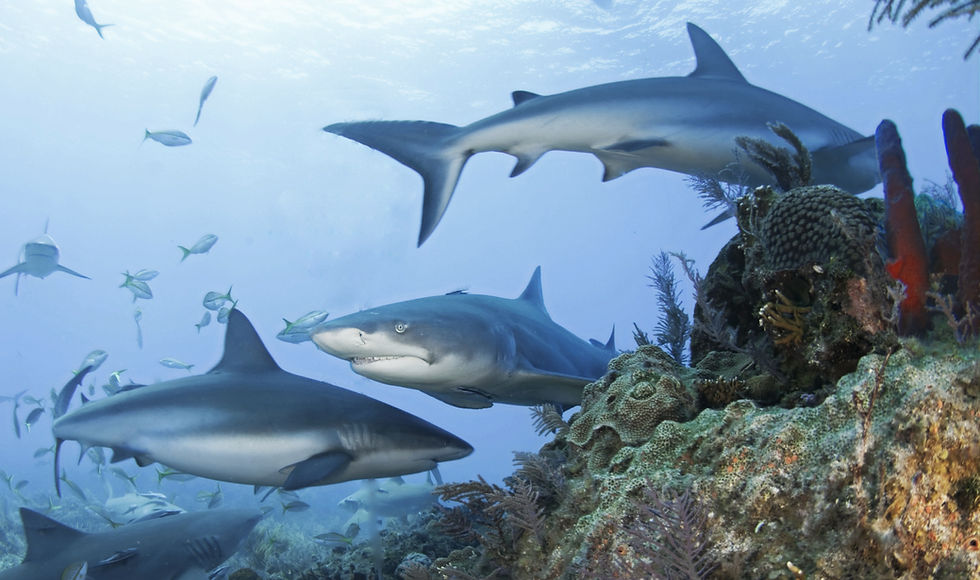
Contrary to common belief, sharks actually have very good eyesight and rely hugely on their vision over relatively short ranges. In fact, in some species of sharks their contrast vision is incredibly acute - much more so than many other animals, including humans! (Ritter, 2004; Schluessel et al, 2014; Collin et al 2015; Meredith et al, 2022).

The exact distance that a particular species of shark can see in the water can vary depending on the conditions: how bright it is, if the water is murky with debris or if there is high wave action. But generally speaking, it's thought that visual species rely upon their sight over about 25 metres or closer and are able to see as far as 100 metres away (Lisney & Collin, 2007; Collin et al 2015.
Numerous different species of sharks - especially those that live in clear waters - rely on their vision in many aspects of their daily lives. Great whites (Carcharodon carcharias), for instance, are primarily visual predators up-close and favour their sight to hone in on their prey when they are closing in. As we now know that these sharks have such good eyesight, it seems unlikely that mistaken identity is a valid explanation for shark bites. To learn more check out Myth Busted: Sharks DO NOT Mistake Surfers for Seals (Bres, 1993; Ritter, 2004; Ryan, 2016; Abel & Grubbs, 2020; Ebert et al, 2021).

Ay, Ay!
The anatomy of sharks' eyes is very similar to that of many other vertebrates, including us - they have a clear region at the front of the eye where light can pass through (known as the "pupil") and there are photosensitive cells on the back of the eye (the "retina"), which are able to detect light and transmit a signal to the brain (Ritter, 2004; Abel & Grubbs, 2020; Ebert et al, 2021).

Yet shark's eyes are different to ours in many ways. Firstly, in how they focus their vision. In human eyes, the lenses are ovoid in shape and muscles attached to each lens stretch it to varying degrees in order to focus an image clearly onto the retina. In sharks the lens does can be spherical or ovoid, but either was it never changes shape. Instead muscle contractions actually move it forwards or backwards within the eyeball in order to look near or far away. More like how you would focus a microscope or a camera lens. This allows them to focus on things very effectively, with short- and long-ranges (Ritter, 2004; Collin et al 2015; Abel & Grubbs, 2020; Ebert et al, 2021).
Secondly, sharks don't have eyelids to close their eyes. These structures are vital for us - to protect and lubricate the eyeball - but in sharks, the eyelids are fixed in place. Only some species have a so-called third eyelid known as a "nictitating membrane", that can come across the eye to protect it from damage (Abel & Grubbs, 2020; Ebert et al, 2021).
In the Dark

Sharks have excellent night vision and many species, such as reef sharks (Family Carcharhinidae) are actually nocturnal hunters. A specialised structure at the back of the eye - called a "tapetum lucidum" - helps to enhance their visual acuity in dark conditions. This reflective membrane bounces light back after it has passed through the retina, so it passes across the photosensitive cells a second time. This increases their chances of seeing every single photon they can; maximising both visual acuity and contrast sensitivity (Abel & Grubbs, 2020; Ebert et al, 2021; Meredith et al, 2022).
Also found in cats and other nocturnal mammals, it's the tapetum lucidum that makes it look like sharks' eyes are glowing in the dark when a torch is shone on them. But this structure is twice as effective in sharks as in cats, so they have excellent night vision (Abel & Grubbs, 2020; Ebert et al, 2021; Meredith et al, 2022).

All Shapes and Sizes
You might never have really considered it, but the size and shape if the pupil has a big impact on sharks' visual acuity. Sharks and their relatives have huge variation in the shapes of their pupils, and each design has evolved because it confers some advantage to that species in their particular ecological niche. The pupils may be round, oval, crescent-shaped, pointed or slits - either vertical or horizontal (Abel & Grubbs, 2020; Ebert et al, 2021).

Crescent-shaped pupils, such as those found in many skates and rays, provide a larger visual field with excellent resolution and high contrast vision. However, slit pupils can be completely closed in bright light and then dilated wide in the dark, which is perfect for sharks that experience a range of conditions, such as deep-diving species. Comparatively round pupils are able to maximise light absorption - perfect for sharks that live in dim conditions in the deep sea, like lantern sharks (family Etmopteridae) (Collin et al 2015).
Vertical slit pupils, like those found in many species of reef sharks (family Carcharhinidae) such as the blue shark (Prionace glauca), can resolve a lot of detail on the vertical plane (Collin et al 2015).

What horizontally slit pupils lack in resolution, they make up for in their extreme width of visual field; that is to say, a wider amount of space seen in perfect focus. Horizontal slit pupils are found on several species of lamnid sharks, including the great white (Carcharodon carcharias), shortfin mako (Isurus oxyrinchus) and the porbeagle (Lamna nasus) because the wide field of vision is very helpful when swimming at rapid speeds, and indeed, these species are some of the fastest sharks on the planet (Collin et al 2015).

In some of the sharks' close relatives - the batoids - the pupil may even be U-shaped, as seen on the giant shovelnose ray (Rhinobatos typus) and in other species, such as the yellow stingray (Urobatis jamaicensis), the pupil is a bizarre half flower-shape, with multiple ovoid pupils joined together. These multiple "pupillary apertures" arise thanks to a flap of iris tissue called the "pupillary operculum", which lies partially over the pupil; in a simple curved shape or in multiple-finger-like projections, creating an intricate, undulating pattern. It is thought that this allows for a larger visual field (Collin et al 2015).

It's Behind You!
Many - but not all - species of sharks have a visual field overlap in front of their faces where both eyes can see. This is known as the "funnel of focus" and it allows for binocular vision. The largest binocular overlap is found in the fastest swimming species, allowing them to be more accurate and nimble as they shoot through the water (Lisney & Collin, 2007; Collin et al 2015).

In general sharks also have a very wide visual field; that is to say, how far around the side of their heads they can see. Because their eyes are located on the side of their head, sharks that can see above and below, and some can even see behind them. The width of the visual field depends on the species, as each type of shark will have a different head shape, and neck flexibility, and the position of the eyes will vary in order to maximise the efficacy of their vision in their particular habitat. For example, in wobbegongs (Family Orectolobidae) and angel sharks (Order Squatiniformes), the eyes are directed upwards, so that they can see far and wide whilst they are lying in wait for prey on the ocean floor (Lisney & Collin, 2007; Collin et al 2015; Abel & Grubbs, 2020).
Thanks to the eye positioning, sharks only have a small, funnel-shaped blind spot near their second dorsal fin that widens towards their tail. The size of this impaired region depends on the species. The sharks with the smallest blind spots and therefore, the widest visual fields are the hammerheads (family Sphyrnidae).

This is thanks to the projection of the eyes out wide off the side of the head by that iconic cephalofoil. Yet they also boast a region of cross-over in front of their faces - where both eyes can see - allowing them binocular vision and excellent depth perception. The winghead shark (Eusphyra blochii) has a four times larger binocular overlap in front of them compared to other closely related species (Order Carcharhiniformes). Whatsmore, five species of hammerheads actually have complete 360 degree vision (Collin et al 2015; Abel & Grubbs, 2020). So far from having bad vision, these sharks can literally see out of the back of their heads!

References
Bres, M. (1993). The behaviour of sharks. Reviews in Fish Biology and Fisheries, 3, 133-159. Access online.
Burt M, Skomal G & Dubielzig R (2021). Unique iris and pupil morphology in lamnid sharks. Access online.
Collin SP, Kempster RM & Yopak KE (2015). How elasmobranchs sense their environment. In Shadwick RE, Farrell AP & Brauner CJ (Eds.). Fish Physiology (Volume 34). Academic Press: UK, pp 19-99. Access online.
Hart NS, Lisney TJ & Collin SP (2006). Visual communication in elasmobranchs. Communication in fishes, 2, 337-392. Access online.
Lisney TJ & Collin SP (2006). Brain morphology in large pelagic fishes: A comparison between sharks and teleosts. Journal of Fish Biology, 68:2. Access online.
McComb-Kobza M (2009). Visual Adaptations in Sharks, Skates and Rays. Doctoral dissertation, Ph. D. Dissertation. Ocean First Institute. Access online.
Meredith TL, Kajiura SM, Newton KC, Tricas TC & Bedore CN (2022). Advances in the sensory biology of elasmobranchs. In: Carrier JC, Simpfendorfer CA, Heithaus MR & Yopak KE (Eds.). Biology of Sharks and their Relatives, third Edition. CRC Press: USA. pp. 143-176.
Ritter E (2006). Understanding Sharks: The Fascinating Behavior of a Threatened Hunter. Krieger Publishing Company: USA.
Schluessel V., Rick IP & Plischke K (2014). No rainbow for grey bamboo sharks: evidence for the absence of colour vision in sharks from behavioural discrimination experiments. Journal of Comparative Physiology A, 200, 939-947. Access online.
Vee, S., Barclay, G., & Lents, N. H. (2022). The glow of the night: The tapetum lucidum as a co‐adaptation for the inverted retina. BioEssays, 44:10, 2200003. Access online.



The McLaren racing team was established by Bruce McLaren in 1963 and has become the second-oldest active F1 team and the second-most successful team, trailing Ferrari in both. Relevant to this, Heuer Carrera is McLaren's first F1 World Constructors' Championship in 1974. In this season, the Marlboro Team Texaco Mclaren-Ford M23 cars of Emerson Fittipaldi and Denny Hulme sported the Heuer logo, and Heuer link timing equipment was used by the team.
Hello
great
I’ve made $84,000 so far this year working online and I’m a full time student. I’m using an online business opportunity I heard about and I’ve made such great money. It’s really user friendly and I’m just so happy that I found out about it. The potential with this is endless.
Here’s what I do…https://www.Rich.salaryhere.Com
JOIN US Everybody can earn 250/h Dollar + daily 1K… You can earn from 6000-12700 Dollar a month or even more if you work as a part time job…It’s easy, just follow instructions on this page, read it carefully from start to finish… It’s a flexible job but a good earning opportunity. tab for more detail thank you……..
.
This is my main concern……………………………………. Www.Cash43.Com