


Pet Names

When we imagine the threats endangered sharks face, what comes to mind for most people is probably finning... but what a lot of people don't realise is that sharks are also fished in their millions for all sorts of other products: their meat for food, their liver oils for cosmetics, and cartilage for herbal medicines, to name a few. Even more shocking is that shark products are rarely accurately listed as an ingredient on packaging, meaning that consumers have no idea what they are buying, and remain unaware of the huge impact they are inadvertently having on shark conservation and overfishing. One such product, believe it or not, is pet food! So which pet foods have shark tissues in them? Are threatened species of sharks used in pet foods? And what impact is this having on declining shark populations?

Copycat
Seafood fraud is the practice of mislabeling fish and other seafoods for sale. It is a massive problem on a global scale, with fisheries products being some of the most regularly falsified goods on the market. In fact, the issue is so widespread that it commonly impacts international trade policies, and leads to significant government and economic losses around the world (Cardeñosa, 2019; Wang et al, 2024).
"The deliberate mislabeling ... of products is an increasingly recognised global problem that can both lead to and conceal the unsustainable use of marine resources"
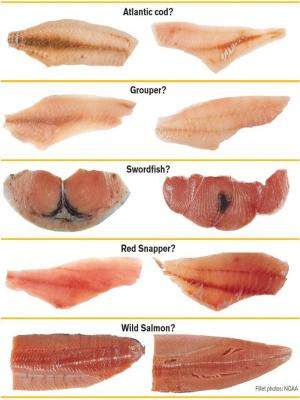
Seafood fraud can be driven by financial gain, as processing of the catch allows fishers and/or manufacturers to pass a product off as something more valuable, in order to make larger profits (Wang et al, 2024).
On the other hand, mislabelling can also be the result of genuine error, as species may simply be misidentified, or the processing procedures - including deheading, descaling, filleting - can remove diagnostic characters, so that items cannot be accurately labelled (French & Wainwright, 2022; Wang et al, 2024).
In the USA and throughout the EU, there are official lists of common and scientific names for food items. However, in most other places inconsistent use of common names to identify species can create honest labelling confusion. For example, in the UK, shark meat is often called huss, flake or rock salmon, rather than the species of shark explicitly. In Taiwan shark products are often described under vague umbrella terms, like 'white fish' (Wang et al, 2024).

The Cat's Out the Bag

Alarmingly, contemporary scientific studies have exposed that seafood fraud is common within the pet food industry. The development of DNA technology now allows for the testing of highly processed, heat-treated and/or mixed ingredient foods, like canned pet foods, to expose what they really contain. As a result, scientists have now exposed that many catfoods contain undisclosed and/or mislabelled shark meat. This list includes (but many not be limited to) various treats, and wet and dry cat foods produced by Sheba, Whiskas, Fancy Feast, Snappy Tom and aristo-cats (Cardeñosa et al, 2017; Cardeñosa, 2019; French & Wainwright, 2022; Wang et al, 2024; Klangnurak et al, 2026).
![A study using DNA Barcoding to analyse which cat foods contain shark meat, discovered that many countries manufacturing these products mislabel [BLUE] the contents (Wang et al, 2024).](https://static.wixstatic.com/media/4039e7_bdd253d032e34f4996aa669378c4a452~mv2.png/v1/fill/w_577,h_438,al_c,q_85,enc_avif,quality_auto/4039e7_bdd253d032e34f4996aa669378c4a452~mv2.png)
Whilst most commonly manufactured in Thailand and Taiwan (Wang et al, 2024), pet foods that invisibly include shark meat are known to have been sold in the USA, Singapore and Taiwan (Cardeñosa, 2019; Klangnurak et al, 2026).
Some DNA studies found that catch-all, generic terms were used on the labels to describe the contents, rather than explicitly listing shark as an ingredient, making it impossible for the consumer to opt-out of purchasing shark products. In other studies, specific details, such as what particular species of shark(s) it contained and/or where they were caught, were not detailed, making it unclear whether the meat had come from a sustainable source (French & Wainwright, 2022; Klangnurak et al, 2026).
![In a study conducted in the USA several different species of sharks, including some threatened species [ORANGE / YELLOW] were found in store- and online-bought cat foods (Image Source: Klangnurak et al, 2026)](https://static.wixstatic.com/media/4039e7_8cc62dfe62af4356b4a7ee60363be94e~mv2.png/v1/fill/w_788,h_483,al_c,q_90,enc_avif,quality_auto/4039e7_8cc62dfe62af4356b4a7ee60363be94e~mv2.png)
Like a Cat on Hot Bricks

Whilst it is deeply concerning that consumers are misinformed, and thus unable to make an informed choice about the products they are buying, what is more alarming is that scientists have discovered many threatened and/or controlled species are included in pet food products (Klangnurak et al, 2026).
A study based in the USA found that 61.8% of the shark species identified in the cat foods tested are flagged as threatened species according to the IUCN (Klangnurak et al, 2026).

This includes Endangered shortfin mako shark (Isurus oxyrinchus) and Vulnerable sandtigers (Carcharias taurus), silky sharks (Carcharhinus falciformes), Caribbean sharpnose (Rhizoprionodon porosus) and sicklefin weasel sharks (Hemigaleus microstoma) (Cardeñosa, 2019; French & Wainwright, 2022). In addition, in a study conducted in Thailand, DNA from several species that are listed as Vulnerable on Thailand's Red Data List - including the new spadenose shark (Scoliodon macrorhynchos) - were found in pet treats (Klangnurak et al, 2026).
Many of these species are also listed on CITES Appendix II, meaning that international trade in their products is strictly controlled (Cardeñosa, 2019; French & Wainwright, 2022; Klangnurak et al, 2026).

Cat Got Your Tongue?
Mislabelling the species of sharks utilised in pet foods unacceptable for many different reasons. Firstly, ethically. Not providing accurate information about the contents of products means that consumers are robbed of the right to make informed choices. In fact, many people may well choose not to purchase such products if they were aware that they included threatened species. Similarly, many consumers may change brands based on religions beliefs; Jewish pet-owners, for instance, may morally object to feeding their pets non-Kosher fish products (Wang et al, 2024).

Secondly, there could be serous health implications. Shark meat is often highly toxic, thanks to significant bioaccumulation of environmental contaminants and heavy metals in top predators. Thus, it could we toxic, or at the very least, not the healthiest choice for beloved pets. Similarly, if owners are not aware of the specific ingredients in their pet's food, it could be challenging to determine the causes of any allergic reaction that may arise (Cardeñosa, 2019; Wang et al, 2024).
"Populations could benefit if consumers [could] choose whether or not to purchase products containing threatened shark species".
Finally, (and, in my opinion, most importantly) pet food mislabelling will have an enormous impact on the sustainable management of fisheries, control of international trade of restricted species and the conservation of Endangered animals. Sharks are massively in decline all over the world, with some populations reduced by as much as 90%, a quarter of all sharks and their relatives now considered to be at risk of extinction in the wild. Yet the global demand for shark products continues to rise. The cat food industry was estimated to account for around 6% of global wild fish catch in 2024 and this is projected to rise by as much as 5.3% by 2027 (Wang et al, 2024).

As consumers, it is vital that we boycott products and brands we deem unethical, and demand internationally consistent product labelling that details the contents, source and sustainability status of the species within processed products, like pet foods. If we continue to over-exploit sharks and blithely allow seafood fraud of shark meat to continue unchecked, the pet food industry could contribute to increasing declines, maybe even threatening the survival of threatened species of sharks (French & Wainwright, 2022; Wang et al, 2024; Klangnurak et al, 2026).

References
Cardeñosa D, Fields A, Abercrombie D, Feldheim K, Shea SK & Chapman DD (2017). A multiplex PCR mini-barcode assay to identify processed shark products in the global trade. PloS one, 12:10, e0185368. Access online.
Cardeñosa D. (2019). Genetic identification of threatened shark species in pet food and beauty care products. Conservation Genetics, 20:6. Access online.
French I & Wainwright BJ (2022). DNA barcoding identifies endangered sharks in pet food sold in Singapore. Frontiers in Marine Science, 9, 836941. Access online.
Klangnurak W, Arunrugstichai S & Manopawitr P (2026). Unveiling the species in shark-based pet snack products with an overview of e-commerce trends. Biological Conservation, 313, 111590. Access online.
Nielsen RO, da Silva R, Juergens J, Staerk J, Sørensen LL, Jackson J, Smeele SQ & Conde DA (2020). Standardized data to support conservation prioritization for sharks and batoids (Elasmobranchii). Data in Brief, 33, 106337. Access online.
Wang YC, Liu SH, Ho HC, Su HY & Chang CH (2024). DNA mini-barcoding reveals the mislabeling rate of canned cat food in Taiwan. PeerJ, 12, e16833. Access online.


hellow