


Cookie Monster

When we hear the term 'shark bite', most people imagine a deadly, toothy gnash. We imagine an enormous great white (Carcharodon carcharias) or a tiger shark (Galeocerdo cuvier) chomping down with hundreds of razor sharp teeth, engulfing the victim whole. However, for the vast majority of the 550 plus species of sharks alive on the planet today, this would not be an accurate description of how they hunt. Many are scavengers, some eat very small prey and some are parasites. Allow me to introduce to you the aptly-named cookiecutter sharks. They may not be the biggest kids on the block, but they boast one of the most spectacularly strange bites out there...

In the Navy
Whilst they were originally described by French naturalists all the way back in the 1820s (Quoy & Gaimard, 1824), cookiecutter sharks (Genus Isistius) really made a real name for themselves in the 1970s, when the US Navy became increasingly concerned about bizarre, round marks they kept finding on the exterior of their deep-sea submarines. Ancient Samoan legends spoke of these unusual wounds seen on dolphins and whales, and American sailors were spooked by the consistency of these mysterious, round markings. Yet all became clear when scientists uncovered the bizarre feeding mechanism of a little-known critter previously dubbed the cigar shark (Jones, 1971).
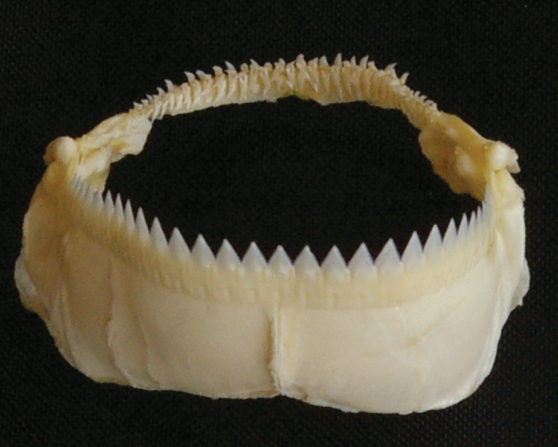
Cookiecutters feed in a completely different way to all other sharks - they only take bites off of much larger animals, like whales, dolphins, orca or larger sharks (and occasionally, military equipment!), and leave their victim alive. This is known as a "hit and run strategy" and means they are nnot just scavengers, but are technically parasites (Grace et al, 2023; (Minaglia & Liegl, 2024).
This is all thanks to their unique mouths. Cookiecutters have robust, modified jaws with vastly different teeth in the upper versus the lower jaws. The slender, thorn-like top teeth are designed to dig in and latch onto flesh. At this point, the fleshy folds of skin around the cookiecutter's mouth can suction on to the victim's skin to create a vacuum. The little shark will then twist and spin its body around - like a crocodile in a death role. This allows the enormous, flattened lower teeth - which are fused to create a singular blade - to excise an almost perfectly round slice of meat from the victim. Like a little cookie (Jones, 1971; Widder, 1998; Grace et al, 2023).

Three's A Crowd
It is undeniable that cookie cutter sharks are some of the most wonderfully weird of all of the shark species alive on our planet today!

But what a lot of people don't realise is that there is not only a single species of cookiecutter. Scientists know of two distinct species and are in debate over a third. As it is far more common and has a worldwide distribution, it is a good bet that people are talking about Isistius brasiliensis when they refer to cookiecutters generally and I. plutodus is referred to specifically as the largetooth cookiecutter shark (de Figueiredo Petean & de Carvalho, 2018; Grace et al., 2023).
Cookiecutter sharks have cigar-shaped bodies and are generally grey or brown, with lighter-coloured tips to their delicate fins. I. brasiliensis also have a distinctive collar of dark pigmentation around their throat, which is the only region of their skin which does not glow in the dark. Yes! You read that right... These little sharks have specialised cells embedded in the upper layers of their skin, which are capable of emitting a bright green glow. (To learn more about other glowing sharks you can check out Twinkle, Twinkle, Little Shark and Glowing in the Deep). Scientists suspect that this allows cookiecutters to actually lure their prey in, as they look like a much smaller, tasty little morsel when seen from below, in the deep, dark oceans (Widder, 1998; de Figueiredo Petean & de Carvalho, 2018).

Bite Me!
As they barely reach half a metre in length and live in the deep oceans, far away from where you might bump into them, you might imagine that cookiecutter sharks are not a threat to human beings. It's true that until recently the International Shark Attack File only logged records where these sharks had been observed scavenging on the body of a dead person - rather than actually attacking a live swimmer in the water (Honebrink et al, 2011).

However, this all changed in 2011, when an athlete who was attempting to swim some 47.5 km between the Hawaiian Islands was injured by a cookiecutter shark. He first suffered a superficial bite to the sternum, and then received a much more serious bite to the leg. Whilst this was thankfully not life-threatening, the wound was significant and required surgical skin grafts (Honebrink et al, 2011).
Cookiecutter sharks undergo a diel vertical migration, where they swim to great depths during the day time and come up into shallower waters to feed at night. On dark nights, as experienced during new moons, cookiecutters will foray into the top chunk of the water column, but will remain slightly more at depth under the light of a full moon. This means that swimmers are most at risk of cookiecutter bites when they cross over deep-water channels on dark, moonless nights (Honebrink et al, 2011; Minaglia & Liegl, 2024).

It is incredibly rare to be injured by a shark and cookiecutter bites are especially infrequent. So please do not fear! To date there have only ever been seven such incidents of cookiecutter bites upon swimmers in the whole world. However, as such long-distance swims are becoming increasingly popular in Hawaii, it seems likely we will see more bites in the future. Scientists and engineers are exploring the possibility of employing shark deterrents or bite-proof suits to provide swimmers some added peace of mind, but recommend that it is most important to reduce the risk by scheduling swims to coincide with the light of the full moon (Minaglia & Liegl, 2024).
References
de Figueiredo Petean F & de Carvalho RM (2018). Comparative morphology and systematics of the cookiecutter sharks, genus Isistius Gill (1864)(Chondrichthyes: Squaliformes: Dalatiidae). PLoS One, 13:8, e0201913. Access Online.
Grace MA, Huber D, Travis K, Doosey MH, Ford J, Decker S & Mann J (2023). Simulating cookiecutter shark bites with a 3D-printed jaw-dental model. Zoomorphology, 14:2. Access online.
Honebrink R, Buch R, Galpin P & Burgess GH (2011). First documented attack on a live human by a cookiecutter shark (Squaliformes, Dalatiidae: Isistius sp.). Pacific Science, 65:3. Access online.
Jones EC (1971). Isistius brasiliensis, a squaloid shark, the probable cause of crater wounds on fishes and cetaceans. Fisheries Bulletin, U.S., 69:4.
Minaglia S & Liegl M (2024). Moonless night sky increases Isistius species (cookiecutter shark) and live human contact. Plos One, 19:2, e0291852. Access online.
Quoy JRC & Gaimard JP (1824). "des Poissons. Chapter IX". In de Freycinet L (Ed.). Voyage autour du Monde...exécuté sur les corvettes de L. M. "L'Uranie" et "La Physicienne," pendant les années 1817, 1818, 1819 et 1820. Paris. pp. 192–401.
Widder EA (1998). Predatory use of counterillumination by the squaloid shark, Isistius brasiliensis. Environmental Biology of Fishes, 53. Access online.
By Sophie A Maycock for SharkSpeak


nice